


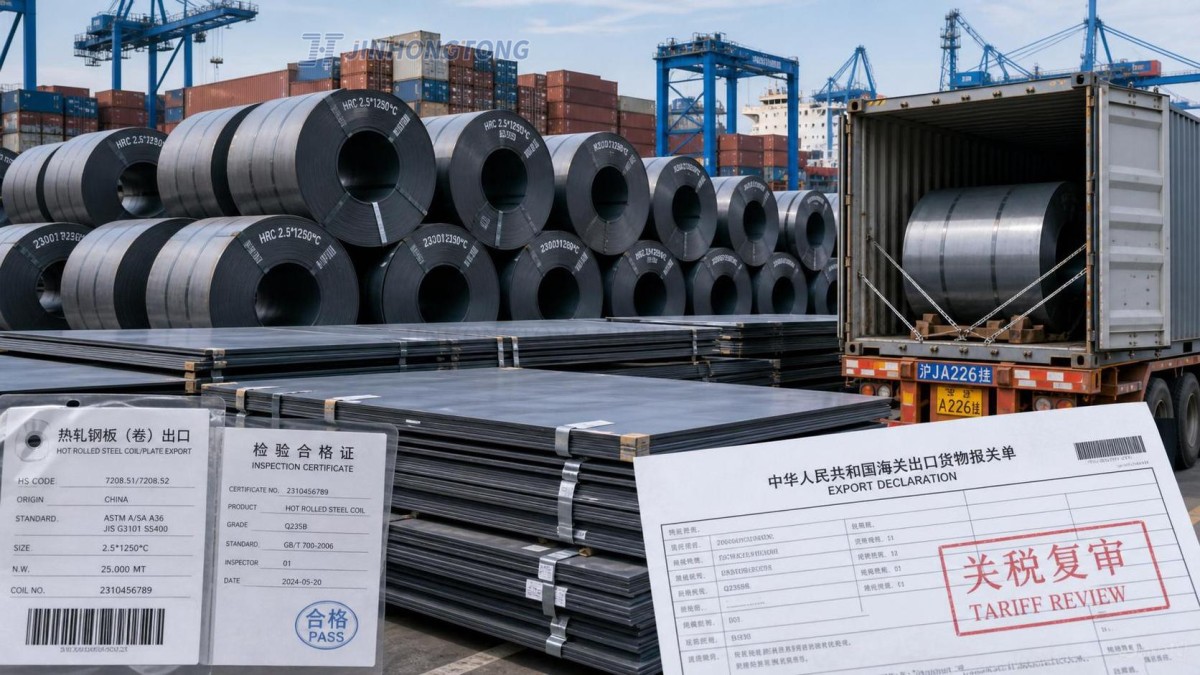
On June 29, 2026, the U.S. Department of Commerce announced an expedited sunset review of the anti-dumping order on hot-rolled steel sheet from China. The review will determine whether the current anti-dumping duty range of 12.5% to 48.3% remains in place, with an expected result before December 2026. For U.S. importers, Chinese exporters, customs teams, distributors, and related supply chain service providers, the development matters because it directly affects second-half pricing, purchasing timing, and document readiness rather than serving as a routine policy update.
What the June 29 Notice Confirms
The confirmed facts are limited but commercially important. The U.S. Department of Commerce initiated an expedited sunset review on June 29, 2026, covering anti-dumping measures on hot-rolled steel sheet from China. The core question in this review is whether the existing anti-dumping duty rates, currently ranging from 12.5% to 48.3%, should be extended. Based on the information provided, the review outcome is expected before December 2026. The same information also indicates that this timetable is relevant to U.S. import purchasing decisions, export quotations from China, and customs clearance documentation preparation in the second half of 2026. It also confirms that market participants in the EU and Canada are watching the development, while some distributors have already started adjusting inventory and supplier qualification review procedures.
Where the pressure may appear across the trade chain
Quoting and order planning face immediate uncertainty
From an industry perspective, Chinese exporters and direct trading companies may feel the impact first in quotation strategy and order negotiation. The reason is straightforward: when the continuation of an existing duty range is under review, price discussions for shipments tied to the second half of the year become harder to finalize. What deserves closer attention is not only the nominal duty range itself, but also how buyers respond to timeline risk before a result is published.
Import procurement may shift toward timing and compliance checks
For U.S. importers and procurement teams, the likely impact is concentrated in supplier selection, purchase timing, and landed-cost evaluation. Analysis shows that the review creates a period in which procurement decisions may depend more heavily on timing assumptions and document certainty. Businesses in this position should pay close attention to any change in official wording, review progress, and the practical implications for entries scheduled before the expected December outcome.
Distributors and stockholders are watching inventory exposure
For distributors and channel operators, the information provided already points to early inventory adjustments and tighter supplier qualification reviews. Observably, these businesses are not only reacting to policy language but also to the risk of holding inventory purchased under one expectation while the market reprices under another. The impact is therefore likely to show up in stocking pace, supplier screening, and replenishment decisions.
Customs and supply chain service teams may see more document scrutiny
Supply chain service providers, including customs-related teams, may be affected through documentation workflows and clearance preparation. The event summary specifically links the review to customs documentation readiness, which means operational attention may shift toward consistency in shipment files, supplier records, and timing coordination. For service providers, the issue is less about policy interpretation in the abstract and more about whether transaction paperwork can support a smoother clearance process under heightened review conditions.
What companies should track now
Watch the official review language closely
Analysis shows that the most immediate task is to follow subsequent official wording around the review rather than assume an outcome too early. Businesses should distinguish between the fact of the review launch and any later determination on duty continuation.
Separate pricing decisions from final-policy assumptions
For exporters and buyers, a practical priority is to avoid treating the current review stage as a settled result. What deserves closer attention is how quotation validity, order timing, and customer communication are handled while the review is still pending.
Recheck document preparation for second-half shipments
The summary provided makes customs clearance preparation a central issue. That means companies involved in shipping, customs coordination, and contract execution should review whether supporting documents, supplier credentials, and transaction records are complete and internally consistent before cargo moves.
Review supplier qualification and inventory decisions together
Because some distributors are already adjusting inventory and supplier qualification processes, companies with exposure to the U.S. market should look at these two issues together rather than in isolation. Observably, qualification review affects not only vendor approval but also replenishment rhythm and customer delivery commitments.
Why this matters beyond a single notice
Analysis shows that this development should be understood as an active market signal rather than a final trade outcome. The review itself does not yet settle the duty question, but it does create a decision window that can influence behavior across purchasing, quoting, stock planning, and documentation work. The added attention from the EU and Canada also suggests that market participants outside the U.S. are treating the move as relevant to broader trade risk monitoring, even though the confirmed event is the U.S. review.
How to read the current stage
It is more appropriate to understand this as a near-term operational risk with wider strategic implications, not as a completed policy shift. In practical terms, the most important point for the industry is that the review timeline now overlaps with second-half commercial planning. Until the expected result is released before December 2026, companies are likely to focus on flexibility in pricing, caution in procurement, and discipline in clearance preparation.
Basis of this article and what still needs verification
This article is based on the user-provided news title, event date, and event summary concerning the June 29, 2026 expedited sunset review by the U.S. Department of Commerce on anti-dumping measures covering hot-rolled steel sheet from China. For this type of development, commonly relevant source categories include official government notices, company disclosures, trade association updates, authoritative media reporting, and standard or compliance-related documents. A specific official source link was not provided in the input, so the exact source document should continue to be verified. The main follow-up point is the official review process and the expected result before December 2026, along with any direct implications for pricing, procurement, inventory decisions, and customs documentation.