


On August 5, 2026, the European Commission formally put into effect new transitional CBAM reporting requirements for imported steel products, turning emissions disclosure into a practical customs and market-access issue for exporters and importers. The change matters to steel exporters, overseas buyers, compliance teams, and supply-chain operators because quarterly reporting of embedded carbon emissions now affects shipment timing, documentation readiness, and access to the EU market.
What Has Taken Effect as of August 5
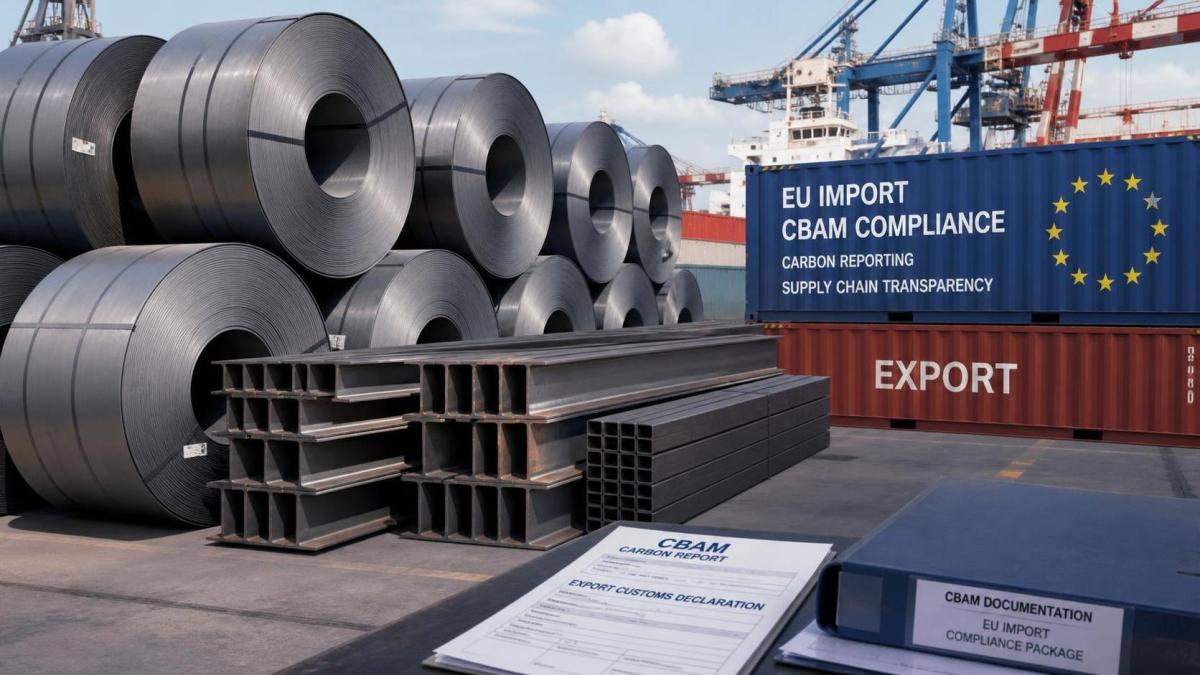
According to the confirmed information provided, the EU CBAM began mandatory quarterly emissions data reporting for imported steel products from August 5, 2026. The covered products include hot-rolled coil, H-beams, square and rectangular tubes, and other steel sections. The requirement applies to all exporters from third countries.
The same confirmed information states that if a certified report on embedded carbon emissions is not submitted on time, customs clearance may be delayed and additional compliance costs may arise. It also confirms that the requirement directly affects the market-access position and delivery rhythm of Chinese steel exporters, while overseas importers must work with Chinese suppliers to prepare MRV documentation and processes.
Where the Pressure Will Appear First
Export transactions now depend more heavily on emissions documentation
From an industry perspective, steel export companies selling into the EU are likely to feel the immediate impact because the reporting requirement is tied to whether goods can move through customs without disruption. What deserves closer attention is that compliance is no longer limited to price, specification, and shipping arrangements; certified embedded-emissions reporting becomes part of the shipment package that supports market entry and delivery execution.
Import-side procurement teams face a coordination burden
Overseas importers are also exposed because the confirmed information makes clear that they must coordinate MRV preparation with Chinese suppliers. Analysis shows that procurement and supply teams may need closer alignment on document collection, reporting schedules, and supplier readiness. In practical terms, purchasing decisions may increasingly consider whether a supplier can provide emissions data in a form that supports timely reporting.
Logistics and delivery planning may become less flexible
Observably, the risk of customs delay means supply-chain service providers and delivery planners may need to treat reporting readiness as part of shipment preparation. Even without additional rule detail in the input, the confirmed consequence of delayed clearance suggests that handoff timing, document completeness, and coordination between exporter and importer become more sensitive than before.
What Companies Should Watch in Daily Execution
Readiness of certified emissions reporting
Analysis shows that one immediate focus is whether exporters and importers can prepare the certified embedded-emissions report within the required quarterly cycle. Since the input does not provide further procedural detail, it is more appropriate to treat this as a compliance checkpoint that requires ongoing verification rather than a fully clarified operating routine.
MRV coordination between supplier and buyer
What deserves closer attention is the MRV interface between Chinese suppliers and overseas importers. Companies involved in EU-bound steel trade should watch whether internal teams, external partners, and suppliers can align on monitoring, reporting, and verification responsibilities in time to support customs processing and contracted delivery schedules.
Impact on delivery commitments and procurement timing
Observably, the rule change may affect how companies set shipment windows, delivery commitments, and purchasing plans for covered steel products. Because late submission may trigger customs delays and added compliance cost, firms should closely review whether current order timelines leave enough room for emissions-reporting preparation and certification-related coordination.
Document control around covered steel categories
From an industry perspective, businesses handling hot-rolled coil, H-beams, square and rectangular tubes, and similar steel sections should pay particular attention to whether product-level documentation and trade files are organized for reporting use. The input does not define additional document standards, so this remains an area where later official clarification and market practice still need to be monitored.
How This Signal Should Be Read
Analysis shows that this development is better understood as an implementation signal rather than a distant policy discussion. The reporting requirement has a defined effective date and a direct compliance consequence, which means companies cannot treat CBAM reporting for covered steel imports as a background issue. At the same time, because the input does not provide fuller detail on execution standards or authority guidance, it should also be read as a rule development that still requires close observation in practice.
Observably, the key point for the market is not only the existence of the rule, but the shift in operational emphasis: emissions data, certification readiness, and importer-supplier coordination are becoming part of the conditions for smooth trade execution.
Why the Market Should Keep Following This
At this stage, the event is most appropriately understood as a real compliance change with immediate operational relevance for steel trade into the EU. Its significance lies in linking CBAM transitional reporting directly to customs timing, compliance cost exposure, and supplier eligibility in practice. A neutral reading is that the requirement has already moved beyond policy signaling, while many of the detailed execution expectations still need to be followed through official interpretation, transactional practice, and market feedback.
Basis of This Article and What Still Needs Verification
This article is based on the user-provided news title, event date, and event summary. For developments of this type, relevant source categories typically include official announcements, releases from regulatory authorities, customs or trade-administration information, industry association updates, standards-related documents, and reporting by authoritative media. A specific official source link was not provided in the input, so it still needs to be verified on an ongoing basis.
Further observation is still needed on detailed policy interpretation, certification and reporting practices, changes in tender or procurement documentation, market feedback, and how affected companies carry out compliance work in actual transactions.