


On July 25, 2026, the U.S. Department of Commerce formally opened the first expedited sunset review of the anti-dumping order covering hot-rolled steel coil from China and kept the current duty range of 12.3% to 248.9% in place. For steel exporters, U.S. importers, traders, and compliance teams, this is not just a procedural update: it directly affects export access to the U.S. market over the next five years and raises immediate questions around supplier qualification, origin documentation, and price declaration practices.
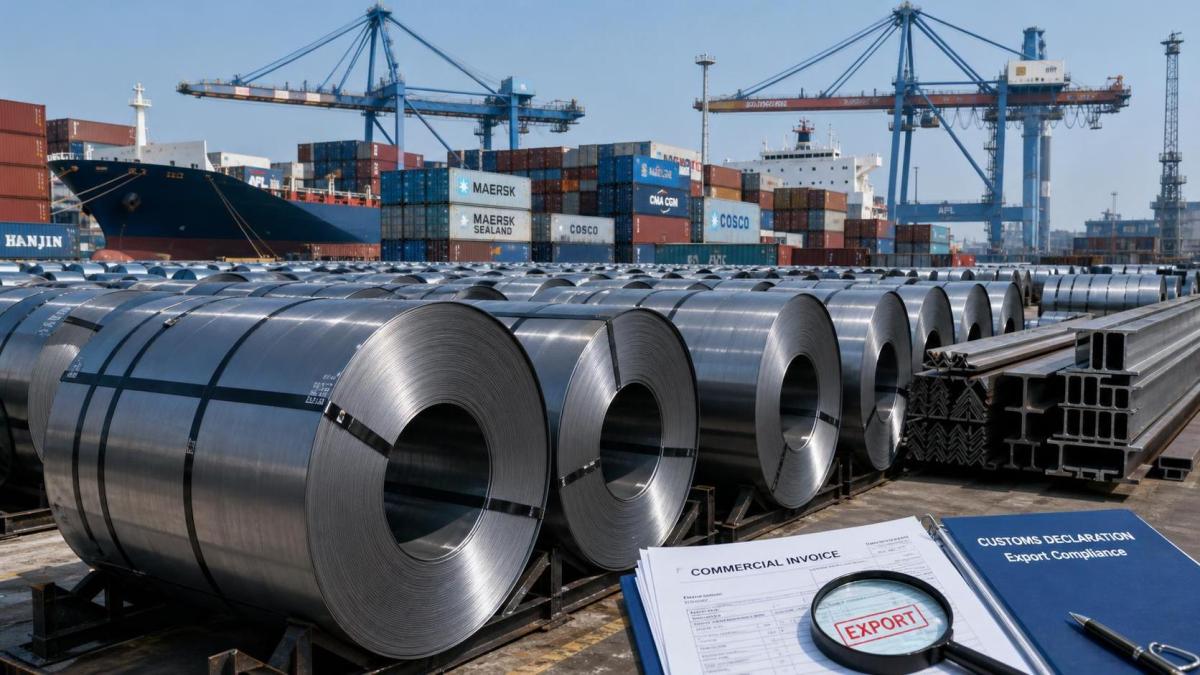
What the July 25 notice confirms
The confirmed facts are limited but commercially important. The U.S. Department of Commerce announced on July 25, 2026 that it had initiated the first expedited sunset review of the anti-dumping duty order on hot-rolled steel coil originating in China. At the same time, the existing anti-dumping duty rates of 12.3% to 248.9% were maintained.
The information provided also makes clear that the outcome of this review will directly affect the eligibility of Chinese steel exports to the United States and the compliance route for customs clearance over the coming five years. Importers are therefore expected to reassess supplier credentials, certificates of origin, and price declaration strategies.
Where the pressure is likely to be felt first
Export and trading activity tied to U.S.-bound shipments
From an industry perspective, companies directly involved in exporting or trading hot-rolled steel coil into the U.S. market may be the first to feel the practical effect. The reason is straightforward: the maintained anti-dumping duty range affects whether shipments remain commercially viable and whether transaction structures can still support compliant entry.
The main pressure points are likely to appear in quotation decisions, customer negotiations, shipment planning, and document preparation. What deserves closer attention is whether existing supplier files and transaction records are strong enough to support ongoing customs compliance.
Import compliance and customs handling
For importers and customs-facing teams, the issue is not only the duty rate itself but also the path to compliant clearance. The provided information explicitly points to origin certification and price declaration strategy as areas requiring renewed review. That means the operational impact may extend beyond purchasing decisions into documentation workflows and internal controls.
Observably, businesses handling entry filings, origin review, or trade compliance should focus on whether current paperwork, supplier statements, and declared pricing logic can withstand closer scrutiny under an unchanged duty framework.
Downstream buyers and processors using hot-rolled coil
Processors, manufacturers, and procurement teams that rely on hot-rolled coil as an input may also need to pay attention, even if they are not filing imports themselves. Their exposure comes through supply continuity, sourcing flexibility, and contract execution where U.S.-related business depends on qualified upstream supply.
The business impact is most likely to appear in procurement planning, supplier communication, and delivery risk assessment. Analysis shows that for these users, the immediate question is less about policy interpretation and more about whether upstream suppliers can continue to meet U.S.-market compliance requirements.
Practical points companies should review now
Recheck supplier qualification files
The information provided specifically highlights the need to reassess supplier credentials. In practice, this makes supplier qualification a priority issue for importers and trading firms connected to U.S.-bound HR coil business. Companies should review whether supplier records, commercial background materials, and supporting trade documents remain aligned with current compliance expectations.
Scrutinize origin documentation
Certificates of origin are identified in the input as a key point of concern. That makes origin-related documentation a core operational issue rather than a routine paperwork step. Businesses should pay close attention to the consistency and completeness of origin records used across contracts, shipping files, and customs submissions.
Review price declaration logic
The event summary also points directly to pricing declarations. Analysis shows that companies should distinguish between a commercial pricing decision and a customs declaration issue, because the two can create different compliance consequences. Internal teams may need to revisit how prices are documented, explained, and matched to transaction files.
Watch for official wording and implementation detail
What deserves closer attention is the difference between the headline decision and its operational meaning. The confirmed fact is that the review has been initiated and existing duty rates are being maintained. Businesses should continue monitoring how official language, procedural updates, or practical enforcement expectations may shape day-to-day execution in sourcing, customs filing, and customer communication.
How this development is best understood at this stage
Analysis shows that this development should not be read as a new market opening or a relaxation signal. Based on the information provided, it is more appropriate to understand it as a continuation of an existing trade remedy framework with renewed relevance for the next five-year period.
At the same time, it is not just background policy noise. Observably, the review matters because it affects whether trade participants can maintain compliant market access and workable transaction structures. That is why the development deserves attention from both commercial and compliance functions, not only from policy watchers.
Why the market will keep tracking this review
The immediate significance of this update lies in its combination of policy continuity and operational consequence. The duty range remains in place, but the practical burden falls on businesses that must prove supplier reliability, document origin correctly, and support pricing declarations in a U.S. customs context.
From an industry perspective, this is better understood as a medium- to long-horizon compliance and market-access signal rather than a short-lived headline. It does not by itself establish a new final market outcome beyond the facts provided, but it clearly indicates that affected companies should continue treating U.S.-related HR coil business as a high-attention area.
Basis of this article and what still needs verification
This article is based on the user-provided news title, event date, and event summary concerning the July 25, 2026 action by the U.S. Department of Commerce on the anti-dumping sunset review of hot-rolled steel coil from China.
For this type of development, commonly relevant source categories may include official government notices, company disclosures, industry association updates, authoritative media reporting, and standard-setting or trade-related documents. A specific official source link was not provided in the input, so the exact source document and any later procedural updates still need to be continuously verified. Follow-up attention should remain on subsequent official wording, any implementation detail affecting customs compliance, and further clarification tied to supplier qualification, origin proof, and price declaration practice.